The steepest road in England — 393 metres at the summit, hairpins at 1 in 3, and a Roman fort beside the road. Here is what driving it is actually like, without the melodrama and without pretending it is nothing.
The road
Hardknott Pass carries a narrow, unclassified road between Eskdale in the western Lakes and the Duddon Valley, topping out at 393 m (1,289 ft). At Cockley Beck on the Duddon side it hands straight over to Wrynose Pass — which reaches exactly the same height — and together the two form the only direct road route between central Lakeland and the Eskdale and Wasdale corner of the district.
The Romans built a road over here in the 2nd century, and their fort — Mediobogdum, better known simply as Hardknott Roman Fort — still stands beside the tarmac on the Eskdale side. Everything that makes the road hard today is what made it strategic then: it is the short way through, and there is no gentle version of it.
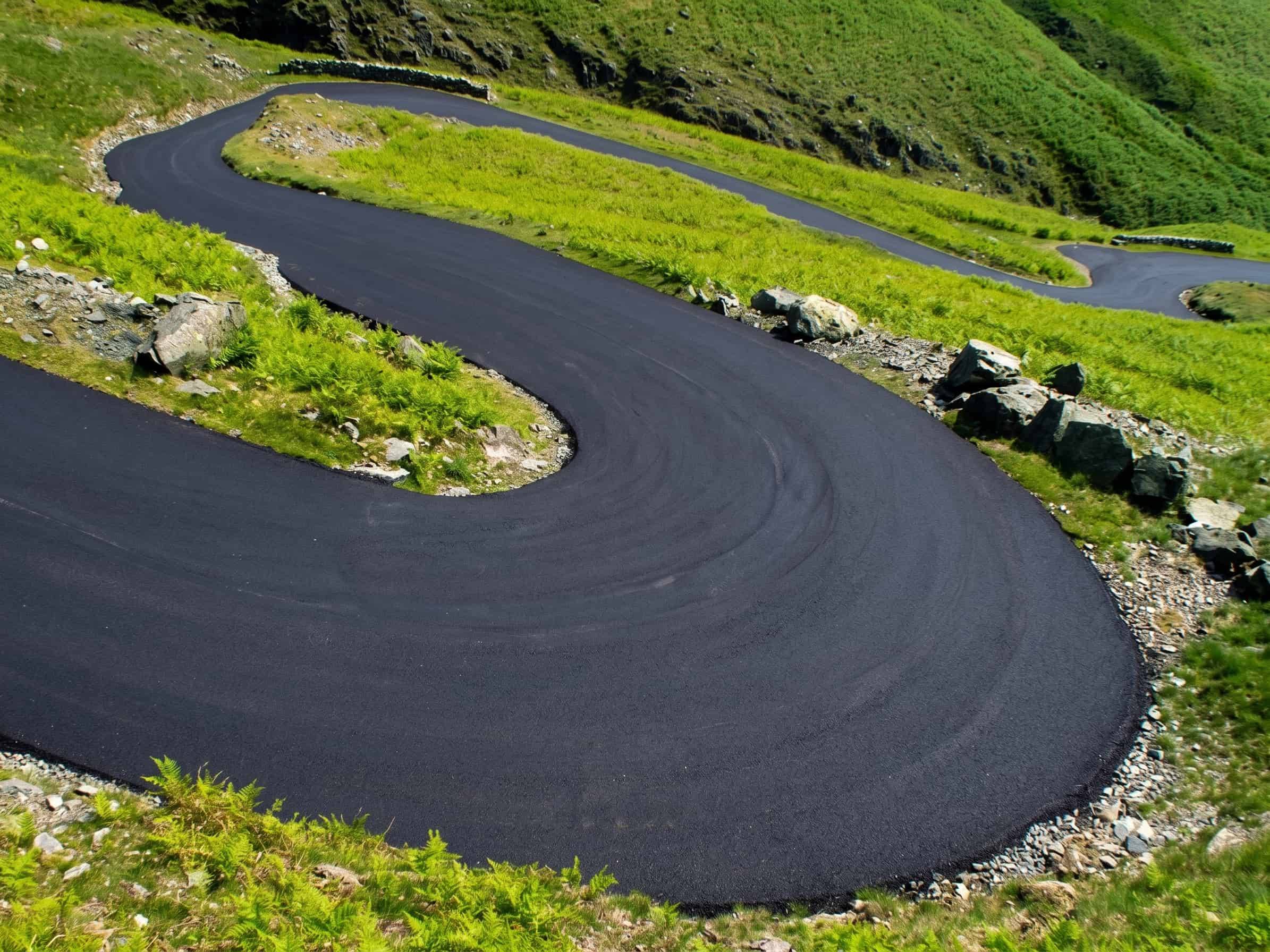
What brings most people here, though, is the number: 1 in 3. Hardknott is the steepest road in England, and unlike most famous drives it delivers exactly what it promises — a stack of hairpins climbing the fellside at a gradient most drivers will never have met before.
Hardknott, Hard Knott, Hardknot? The Ordnance Survey writes the fell as Hard Knott and the road as Hardknott Pass, and the internet spells it every way imaginable. However you found us, this is the 1 in 3 between Eskdale and the Duddon — you are in the right place.
Behind the wheel
Can an ordinary car do it? Yes — in good conditions, thousands do every summer, and the pass needs no special vehicle. What it does need is a driver who is comfortable on steep, narrow, committing roads, because Hardknott is all three at once: hairpins at 1 in 3, single-track in places with passing places, blind bends, and sections with little between you and the drop.
The part that catches people out is not the steepness — it is meeting someone on it. Two vehicles cannot pass on the tightest sections, and the one facing downhill or nearest a passing place reverses. Reversing uphill round a hairpin on a 1 in 3 is the manoeuvre nobody practises. Watch the road ahead, plan where you would pull in, and never park in a passing place.
Gears, not brakes. Go up in a low gear and stay in it; come down the same way. Riding the brakes down the far side is how they overheat, and the descent is as steep as the climb whichever way you cross. The famous stacked hairpins are on the Eskdale side; from that direction you climb them, from the Duddon side you descend them.
When not to drive it: in snow or ice — it closes, and it is genuinely dangerous before it is officially shut — and think hard in heavy rain, low cloud or darkness. Caravans, trailers and large motorhomes should not attempt Hardknott at all. The A595 coast road goes around the whole massif and gets you to Eskdale the long, sane way; slower on the map, and frequently faster in practice.
There is no shame in the alternative: the A595 runs around the western edge of the Lakes and reaches Eskdale from the coast, with nothing steeper than an ordinary main road. If the description above sounds like a test rather than a drive, that is your route — the valley is just as beautiful arrived at gently.
The number
Hardknott reaches 1 in 3 — about 33 per cent. That makes it the steepest road in England, a distinction it shares with Rosedale Chimney Bank in Yorkshire. This is worth stating precisely, because the wider web routinely gets it wrong in both directions — crediting Honister with the title, or inflating Hardknott beyond it.
| Pass | Max gradient | Summit |
|---|---|---|
| Hardknott | 1 in 3 · about 33% | 393 m |
| Wrynose | up to 1 in 4 · 25% | 393 m |
| Honister | 1 in 4 · 25% | 356 m |
| Kirkstone | 1 in 4 · The Struggle | 454 m |
For every three metres forward, the road climbs one. Most motorway slip roads and "steep" suburban hills are under 1 in 10. Multi-storey car park ramps — the steepest thing many drivers ever meet — are gentler than this. And Hardknott delivers its 1 in 3 on hairpin bends, which is why first gear is not a suggestion.
Beside the road
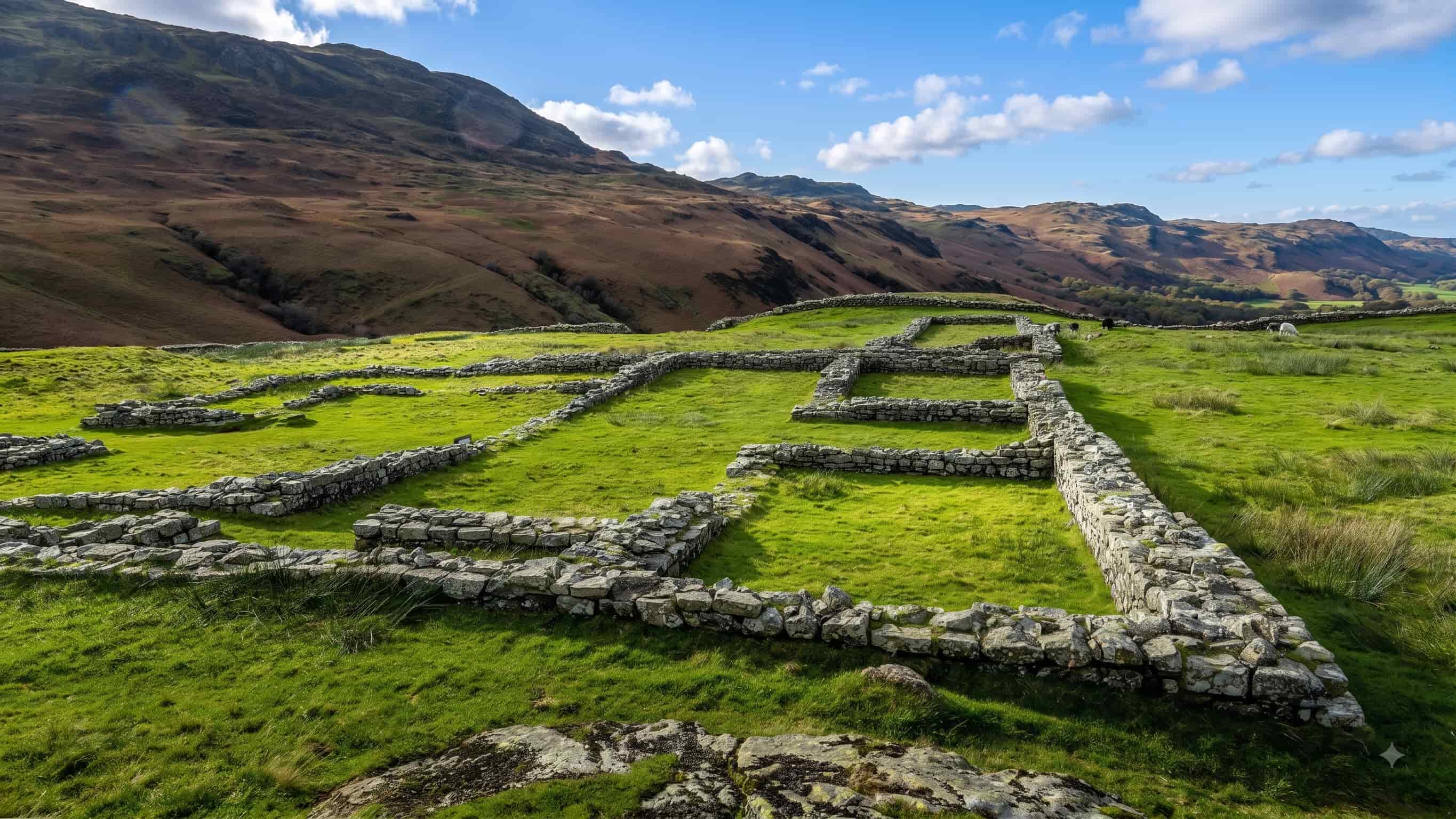
Partway up the Eskdale side, on a green shelf above the road, stand the remains of Mediobogdum — a Roman fort built in the 2nd century, in the reign of Hadrian, to guard the road the pass still follows. It is often described as one of the most spectacularly sited Roman forts in Britain, and standing inside its walls looking down Eskdale to the sea, it is hard to argue.
The walls, headquarters building, commandant's house and bath house are all clearly traceable, with the parade ground levelled out of the fellside above — a remarkable amount survives for somewhere so remote. It takes twenty minutes or a whole afternoon, depending on how long you stand there wondering what a posting here felt like in February.
Visiting is free and needs no ticket: it is an open-access English Heritage site, open at any reasonable time. Parking nearby is limited to small pull-ins on the Eskdale side of the pass, with a short, steep walk up to the fort — and in winter the access shares the road's problems.
Worth stopping for
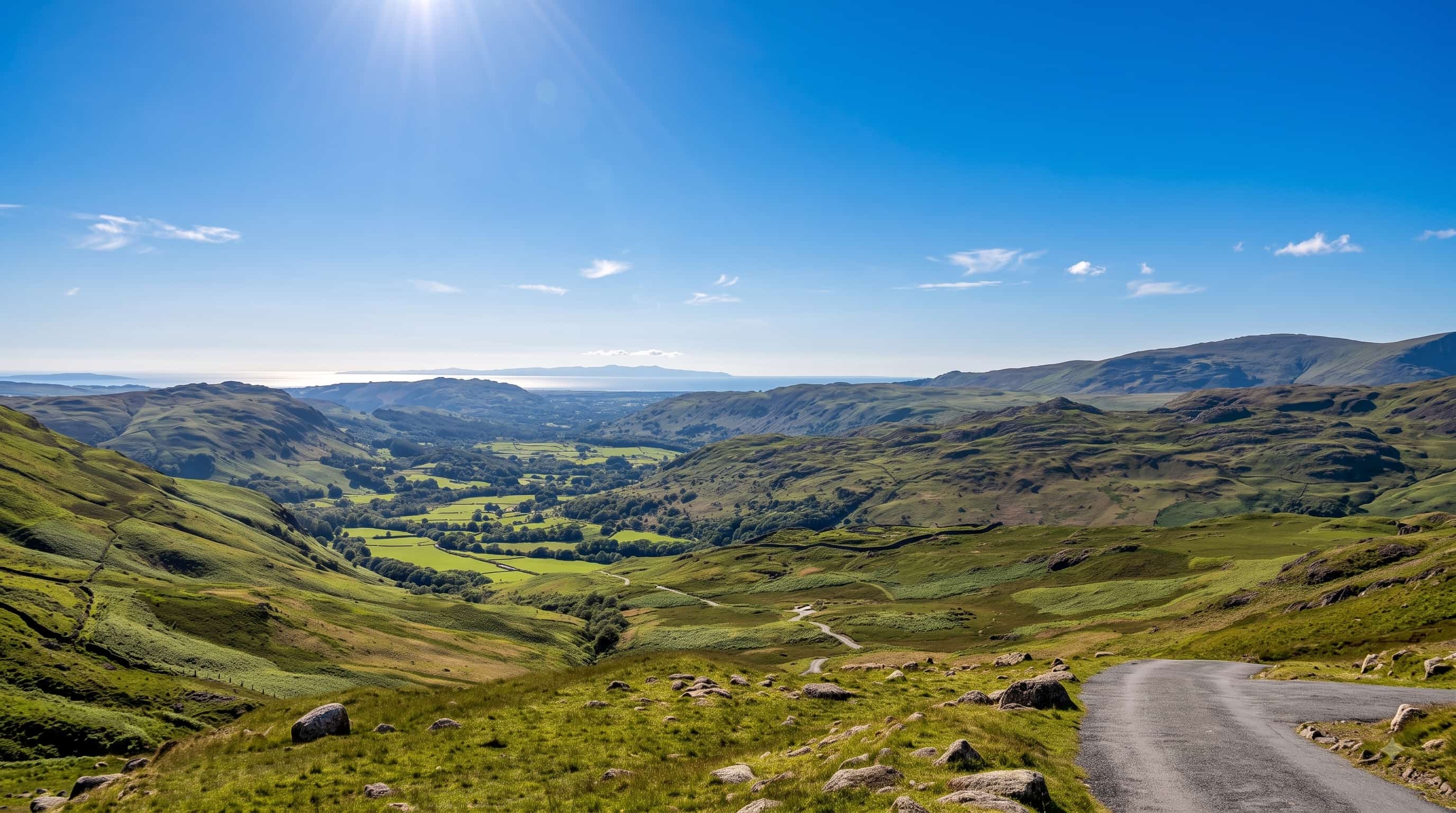
The photograph at the top of this page is the one that makes the drive worthwhile: from the summit, the whole of Eskdale unrolls westward to the Cumbrian coast, with the road you have just climbed winding away below. On a clear evening the light comes straight up the valley from the sea, and there are few better road-accessible views in the district.
To be honest about what that photo is not: it is the view from the top, not the famous stacked hairpins — those are below you on the Eskdale side, and are best seen (and photographed) from partway up the valley floor. From the fort, meanwhile, you get the reverse angle: the Scafell massif rising at the head of the valley.
Stop properly to enjoy any of it — there are small pull-ins near the summit. Stopping on a 1 in 3 hairpin to take a picture is neither safe nor popular with the traffic behind you.
The classic drive
Most people do not drive Hardknott in isolation. The classic run takes both passes in one go: from Little Langdale over Wrynose, along the wild upper Duddon Valley to Cockley Beck, then over Hardknott and down into Eskdale — or the same in reverse. The two summits stand at exactly the same height, 393 m, with the deep trench of the Duddon between them.
Be honest with yourself about what you are taking on: it is not many miles, but almost all of them are single-track with gradients, and it takes far longer than the distance suggests. There are no fuel stops, no phone signal to rely on, and once you are between the passes the only ways out are over a summit or the long lane down the Duddon. Allow a generous chunk of the day, go in good weather, and it is one of the great drives in Britain — hurry it, and it is just stress with scenery.
On two wheels
Hardknott is one of the most feared climbs in British cycling, and the reputation is earned: 1 in 3 is beyond what many riders can turn over at all, on fresh legs, in perfect weather. The hairpins force you into the steepest line at the worst moments, and the surface on the hardest ramps is rarely kind.
Its fame rests on the Fred Whitton Challenge, which crosses it with roughly 100 miles already ridden — the event's crux, and the place where walking becomes a rite of passage rather than a failure. If you want to ride it for its own sake, come on fresh legs and pick a quiet morning: meeting descending traffic mid-hairpin is as much of a hazard on a bike as in a car.
Before you set off
This page cannot tell you whether the pass is open right now, and you should not trust any page that claims to. What we can give you is the pattern: Hardknott closes in snow and ice — sometimes for days at a time — and it is one of the first roads in the district to become undriveable when temperatures drop, because nothing about a 1 in 3 hairpin works on a frozen surface.
Conditions at 393 m bear little relation to the valleys, and a clear morning in Ambleside or Eskdale tells you nothing about the top. In winter, check before you commit, and have the A595 coast route in mind as the fallback. If in doubt, go round: the pass will still be there on a better day.
Common questions
The other half of the classic run — same 393 m summit, and the Three Shire Stone at the top.
The highest Lakes pass open to traffic — and a far gentler drive than this one.
Borrowdale to Buttermere at 1 in 4 — often confused with Hardknott, and not the 1 in 3.
The wild western corner the pass unlocks — Wastwater, Scafell Pike and Great Gable.