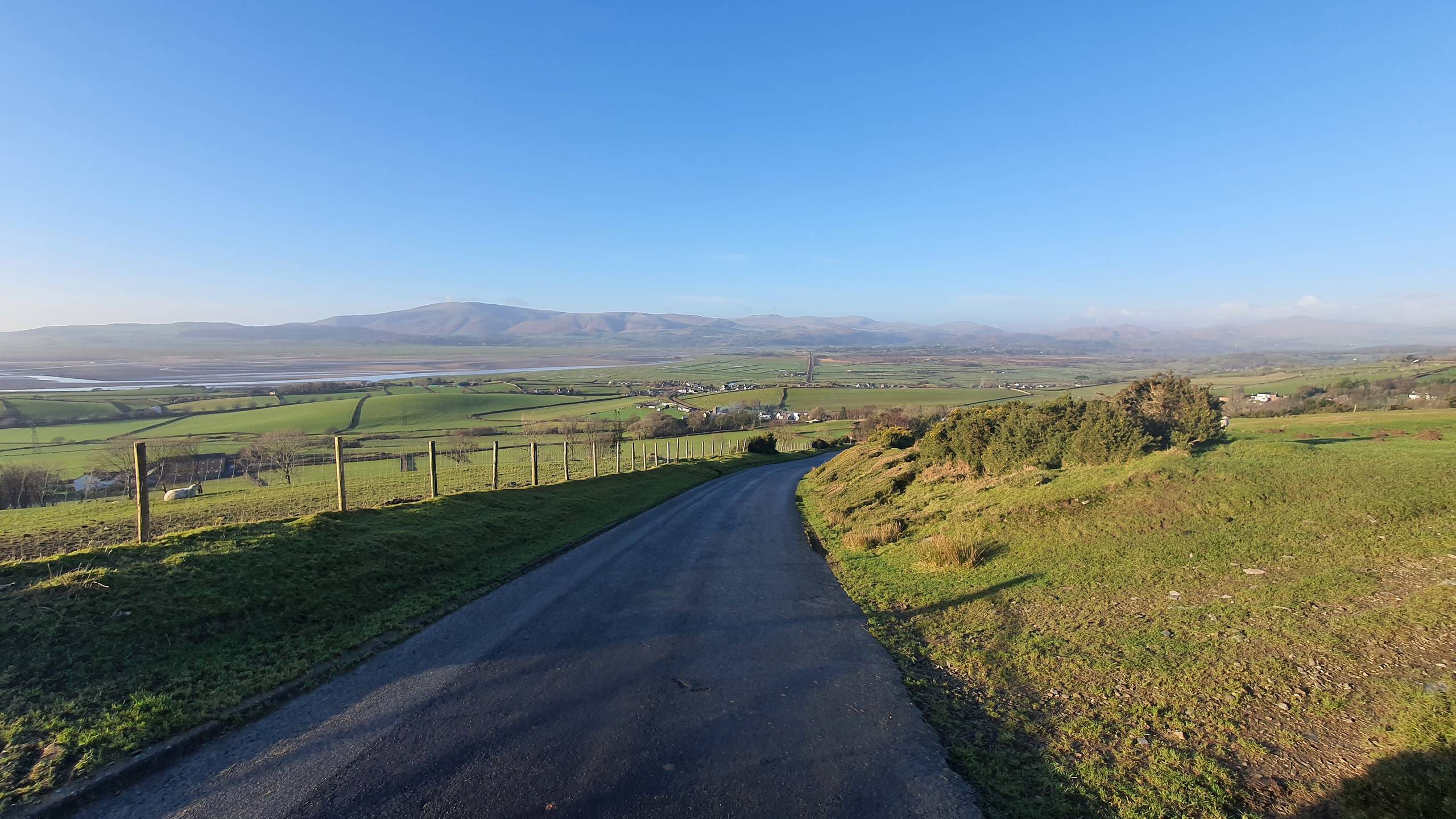
Roman walls still standing almost four metres high, free to walk up to at any reasonable hour — plus a narrow-gauge railway into Eskdale and a castle up the road.
Start here
Ravenglass is the only coastal village in the Lake District National Park. That single fact explains most of what it is: everywhere else in the National Park is inland, and this is the one place where the fells run out into a harbour.
It sits where three rivers — the Irt, the Mite and the Esk — converge into a natural harbour before meeting the sea. That confluence is not a scenic detail; it is the reason there is a village here at all. A sheltered anchorage on an otherwise exposed coast is exactly what the Romans wanted, and it is why they built a fort here.
What makes it worth a day rather than a stop is how much sits within a few minutes of each other: the Roman bath house, free and open at any reasonable hour; the narrow-gauge railway running inland up Eskdale; and Muncaster Castle just up the road.
The reason to come
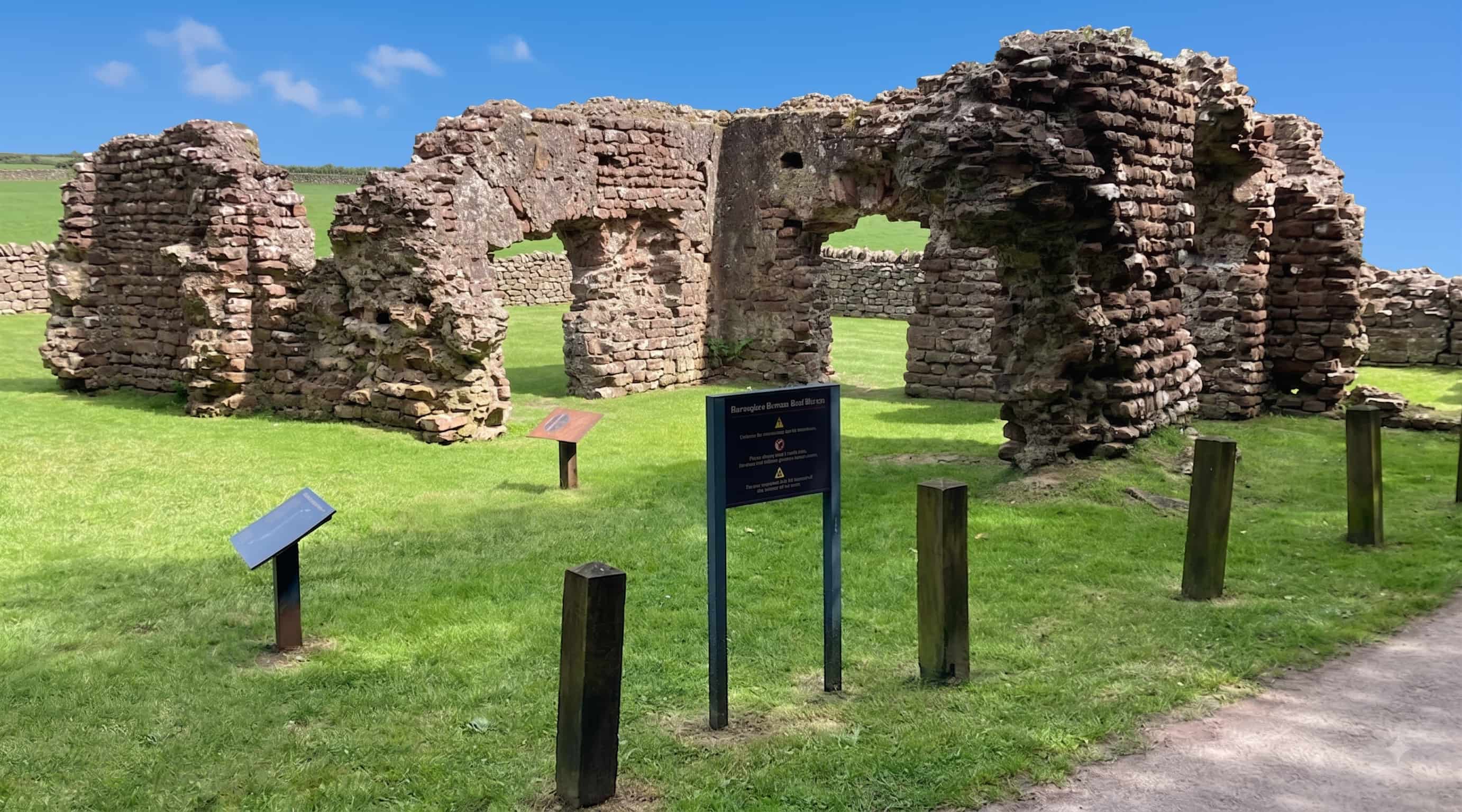
This is the bath house of the Roman fort at Ravenglass, established around AD 130 — and it is the most under-visited significant Roman site in the north-west.
The walls stand almost 4 metres high. English Heritage describes it as among the tallest surviving Roman structures in northern Britain; Historic England's scheduled monument listing goes further, calling it the best-preserved Roman military bath-house building in the country. That is a strong claim and it belongs to Historic England rather than to us — but it is worth knowing before you decide whether to make the trip, because it is easy to assume from the roadside that this is a modest ruin.
Free, and open access. There is no ticket office, no opening hours and nothing to book — it is accessible at any reasonable time, in the guardianship of English Heritage. One practical catch: English Heritage does not manage the parking. There is charged public parking in the village, and the bath house is signposted from the car park.
Four rooms stand to almost 4 metres. Look closely at the wall faces and you will find rare remains of the original Roman white and pink mortar still in place — not a reconstruction, the actual surface the builders left. There is also a niche in what was probably the changing room, crowned with a red arch, which may once have held a statue.
English Heritage is candid that how it survived to that height remains something of a mystery. Roman buildings in Britain were usually quarried for stone centuries ago. This one was not.
The site is also known as Walls Castle, and the reason is the best story here.
It drew antiquarian attention from the early 17th century, but for most of that time nobody knew what they were looking at. It was long assumed to be medieval — hence "castle". Only in the late 19th century, when excavation turned up hypocaust supports — the pillars of a Roman underfloor heating system — was it recognised as Roman at all. Even then it was taken for a villa. It was not identified as a bath house until 1919.
So a building that had stood in plain sight for three hundred years of scholarly attention spent almost all of it misfiled. It is a useful reminder of how recent a lot of "ancient" knowledge actually is.
The fort's earthworks are visible near the bath house, though it has had a hard two centuries: a railway was driven across it in the 1850s, and the sea has destroyed its western defences entirely. The northern defences are best seen across the fence opposite.
One detail gives the place its scale: the soldiers stationed here served in Hadrian's fleet. This was not a backwater outpost but a working naval station on the Empire's north-western edge. English Heritage links Ravenglass by Roman road to the forts at Hardknott and Ambleside — stand at Hardknott's fort on its shelf above Eskdale and you are looking along the same military line.
Postcode CA18 1SR. A marked footpath runs from the back of the village car park, crossing the railway by footbridge towards the site.
Inland from the coast
The narrow-gauge line runs seven miles from Ravenglass up to Dalegarth for Boot at the head of Eskdale, taking about 40 minutes each way, with seven intermediate request stops.
It is known locally as La'al Ratty — "little railway" in old Cumbrian dialect — which is why you will see it searched for under that name as often as its own.
Five heritage steam engines are in operation. The oldest, River Irt, built in 1894, is described by the railway and by Visit Lake District as the world's oldest working narrow gauge steam engine. The journey is also said to have been one of Alfred Wainwright's favourites — a claim that appears on the operator's and Visit Lake District's pages rather than in Wainwright's own books, so take it as received wisdom rather than gospel.
What lifts it above a novelty ride is that it is genuine transport. Eskdale has very little parking and a hard road in over the passes; the railway puts you at the head of the valley without a car.
You do not need a train ticket to visit the cafés or the gift shops. Almost nobody mentions this, and it changes what a visit can be. The 1876 Ravenglass Station Café and the 1876 Dalegarth Station Café both do eat-in and takeaway, with times and menus varying by the timetable. The Ravenglass Railway Museum is free too — donations welcome. There are children's outdoor play areas at both main stations, and free Wi-Fi.
The booking system has more structure than most heritage lines, and the details are worth reading before you buy rather than after:
Dogs, bicycles and wheelchairs are all accepted on the trains, with water bowls around the site. Dogs are not permitted at selected events, nor in the Joan Pullman Observation Carriage, First Class Carriage '140' or the 'Ruth' Director Saloon — assistance dogs excepted. Because carriage type is fixed at booking, that is a decision to get right at the start. There is also a Dog Rover season ticket, with a share of each sale going to the Dogs Trust.
If you live locally, there is a resident's pass giving 25% off adult and child full-line fares, excluding special event days. It is easy to miss and rarely written about.
Arriving by train? Combined tickets exist with Northern on the Cumbrian Coast line, and through-ticketing is available via National Rail — though passengers arriving on a through ticket need to go to the railway's own ticket office to be booked onto a service. A through ticket is not a seat.
Fares and timetables are the operator's, and they move. We deliberately publish neither — a stale departure time is worse than no departure time when you are standing on a platform. The railway's timetables and fares page carries the current running pattern and a downloadable timetable; the plan your visit page covers the rest.
Postcodes: CA18 1SW Ravenglass Station, CA19 1TF Dalegarth for Boot.
Set your expectations
Worth being straight about this one, because the word "beach" does a lot of work it shouldn't here. Ravenglass sits on a tidal estuary, not a bathing beach.
What you get is the shoreline where the Irt, the Mite and the Esk come together and meet the sea: shifting channels, strong tidal flow, and wide mudflats and sandflats exposed at low water. The character changes completely between tides — the same walk gives you a broad expanse of sand and channels at low water and a full harbour at high.
It is a good place for a walk, for birds and for the view. The estuary and the dunes beyond it draw waders and seabirds, and the outlook across to the dune system is the sort of wide, empty coastal view you do not get anywhere else in the National Park.
This is not a swimming spot, and we are not going to dress it up as one. Estuaries with three converging rivers carry fast, changeable tidal channels and soft ground. Come for the walk and the birds. If swimming is what you are after, that is a different kind of place entirely.
Up the road
Muncaster Castle sits on the A595 just east of Ravenglass — close enough that the two are routinely done as one day, and the operators sell a ticket that assumes exactly that.
The joint ticket covers one Muncaster visit and one return rail journey, and includes free entry to the Ravenglass Railway Museum. Two details make it more flexible than it first looks: it is valid within 7 days from first entry, so it works as a two-day trip as comfortably as one long one — and it is online only, so it is not something to decide at the gate.
As everywhere else on this page, we do not print the figure. The operators publish it and theirs will be right.
Road, rail and bus
By rail: this is the unusual one. Northern's Cumbrian Coast line serves Ravenglass directly, connecting north towards Carlisle and south towards Barrow-in-Furness — and the narrow-gauge terminus is right there. Ravenglass is one of very few places in the Lake District you can reach by train and then keep travelling by train.
By bus: Stagecoach 7 and X7 serve the coast road.
By road: Ravenglass sits just off the A595 on the west coast. There is charged public parking in the village, by the station, and a marked footpath leaves the back of it, crossing the railway by footbridge towards the bath house.
Coming from Ambleside or the central Lakes? Sat nav will send you over Wrynose and Hardknott — 1 in 3 hairpins, and frequently closed in winter. Operators along this coast warn their own visitors off relying on it. The A595 down the coast is longer on the map and the one that works all year.
Distances are best thought of from Ravenglass, Boot and Ambleside rather than from any lake — this is the coast, and the map is misleading about how long the west of the National Park takes to reach from the middle of it.
A fair comparison
It gets asked a lot, and the honest answer is that it depends which side of the National Park you are on — the two main heritage lines are not really competing.
The Ravenglass & Eskdale Railway is narrow gauge, on the west coast, running seven miles inland from the sea up into a valley with very little parking. It functions as transport as much as an attraction: you can arrive by mainline train, change onto it, and spend a day in Eskdale without a car.
The Lakeside & Haverthwaite Railway is at the southern end of Windermere, in the south-east of the National Park, and connects with the lake steamers — so it pairs with a boat rather than a valley.
Different gauges, different parts of the district, different days out. We are not going to declare a winner, because the one that suits you is decided by where you are staying and whether you want a lake or a valley at the far end.
The honest verdict
For Roman history, yes — and more than most people expect. There are very few places in England where you can walk up to Roman walls standing almost four metres high, with no ticket, no gate and no opening hours. That it is free and largely unvisited is the whole appeal.
It suits you if you like history you can walk into, you would rather arrive by train than fight for a parking space, or you want a full day built from three things a few minutes apart — the bath house, the railway and Muncaster.
It suits you less if you are expecting a seaside village in the traditional sense. The beach is a tidal estuary, not a resort shoreline, and the village is small. It is also a long way from the central Lakes: the direct road crosses Hardknott and Wrynose and the reliable way in is the coast road.
This guide is desk-researched from English Heritage, Historic England and the railway operator's own published information. We have not walked the village ourselves for this page, and where a source could not be settled — the fort's Roman name, which appears in three conflicting forms — we have left it out rather than pick one.
Common questions
Where the little railway goes — Boot, the working water mill and Stanley Ghyll Force.
Just east on the A595 — and the other half of the joint ticket.
The Roman fort up the valley, once linked to Ravenglass by road.
Where the bath house sits among the odder Lake District days out.