🏰 Lowther Castle — what's free, what you pay for, and everything the ticket page doesn't tell you.
4 miles south of Penrith Dogs on leads welcome
🏰 CA10 2HH · 4 miles south of Penrith · M6 J40
Lowther Castle & Gardens: A Complete Visitor Guide
A great Gothic house that was deliberately taken apart — roof removed, fittings sold, the shell left standing. Around it, 130 acres of restored gardens and one of the country's largest wooden adventure playgrounds. This guide answers the questions the ticket page doesn't: what's genuinely free, what you actually pay for, and whether it's worth your day.
Partly — and the honest answer is more useful than a straight yes or no. The wider parkland is free to walk: the estate's own guidance is that visitors are welcome to walk anywhere in Lowther Park that is not marked private. The castle ruin, the restored gardens and the Lost Castle playground are not — all three sit inside a paid boundary, and you cannot see them properly from outside it.
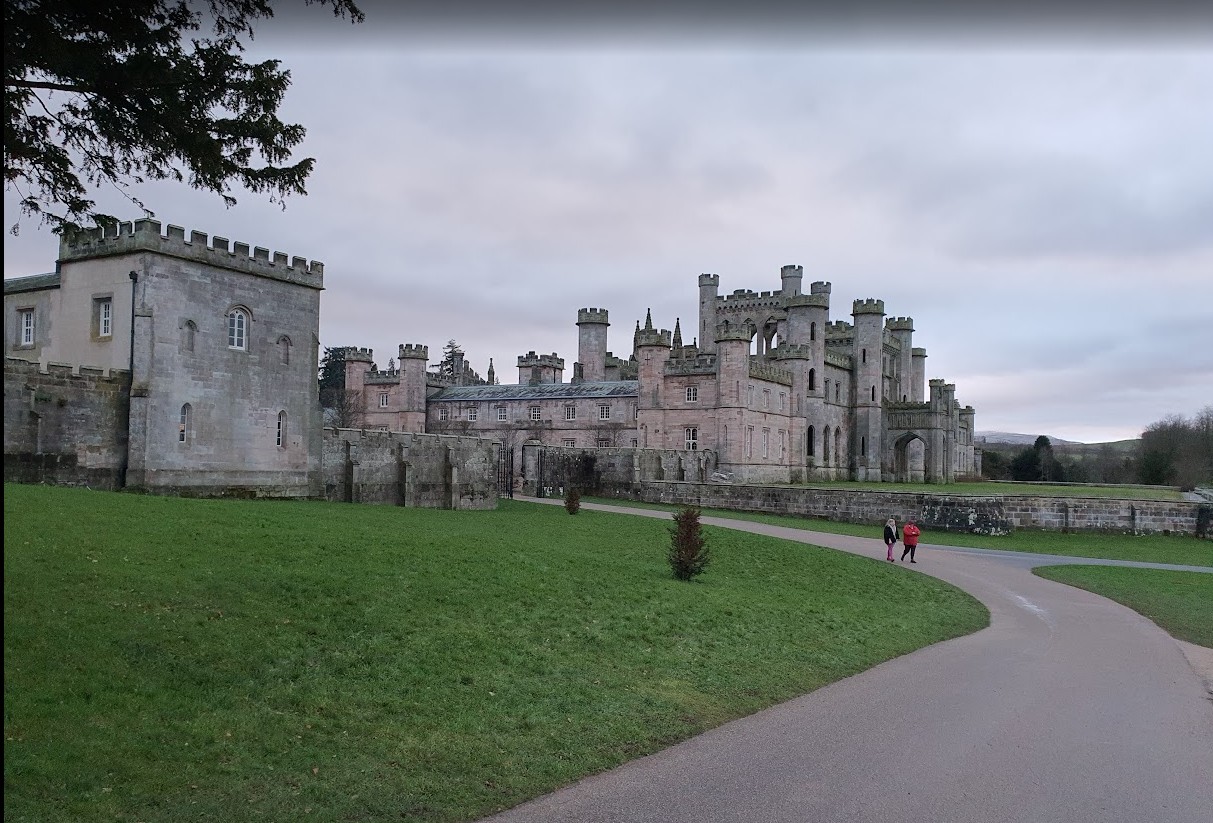
So you can spend a good half-day walking the park, the riverside and the estate rights of way without buying a ticket. You will get distant views of the castle silhouette and a real sense of the scale of the place. What you will not get is the Garden-in-the-Ruins, the Parterre, the Western Terrace or the playground.
The catch worth knowing. Parking at the castle car park is charged per day whether or not you buy an entry ticket. If you drive in, park up and walk only the free paths, you will still pay to park. A genuinely free visit means starting from somewhere else — Askham and Helton both sit on the Lowther Castle Loop, and the wider Ullswater Way network links in at Pooley Bridge.
Two practical notes from the estate: the Lowther Estate herd of cattle roams free in the park, so dogs go on leads; and there are no bins — take your litter home.
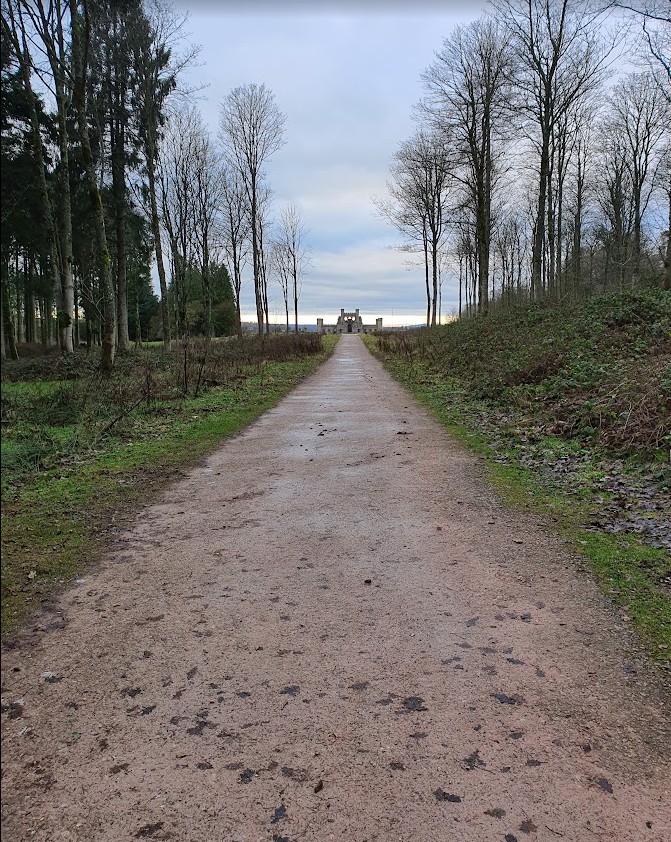
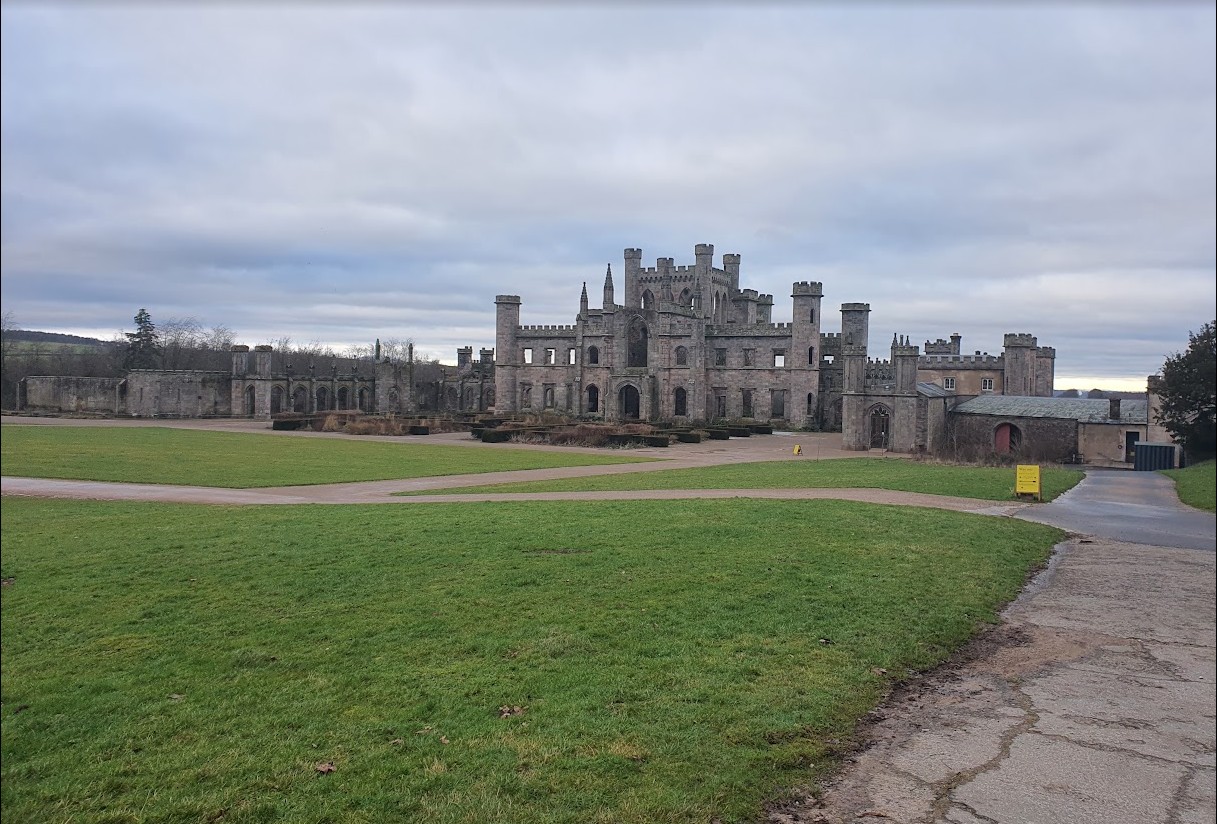
The long approach to the castle. Much of the walking here is like this — level, wide and open.
The deer park is the open parkland north and west of the gardens, part of the wider Lowther Park that surrounds the castle. It is outside the ticketed boundary, crossed by rights of way, and free to walk under the same estate guidance as the rest of the park — anywhere not marked private, dogs on leads, litter home.
It is not a visitor attraction with a gate and an opening time. There is no deer-park ticket, no deer-park car park and no facilities. Treat it as parkland you walk through, usually as part of a longer route.
The deer park also hosts the music festival Kendal Calling each summer — which, despite the name, is held here near Penrith rather than in Kendal. Anything time-sensitive about the festival lives on its own site.
Don't expect to see deer on demand. The herd ranges across a very large area either side of the castle, in and out of the tree cover, and there is no enclosure or viewing point to walk to. Sighting them is luck rather than itinerary — treat it as a bonus on a walk, not the reason for one.
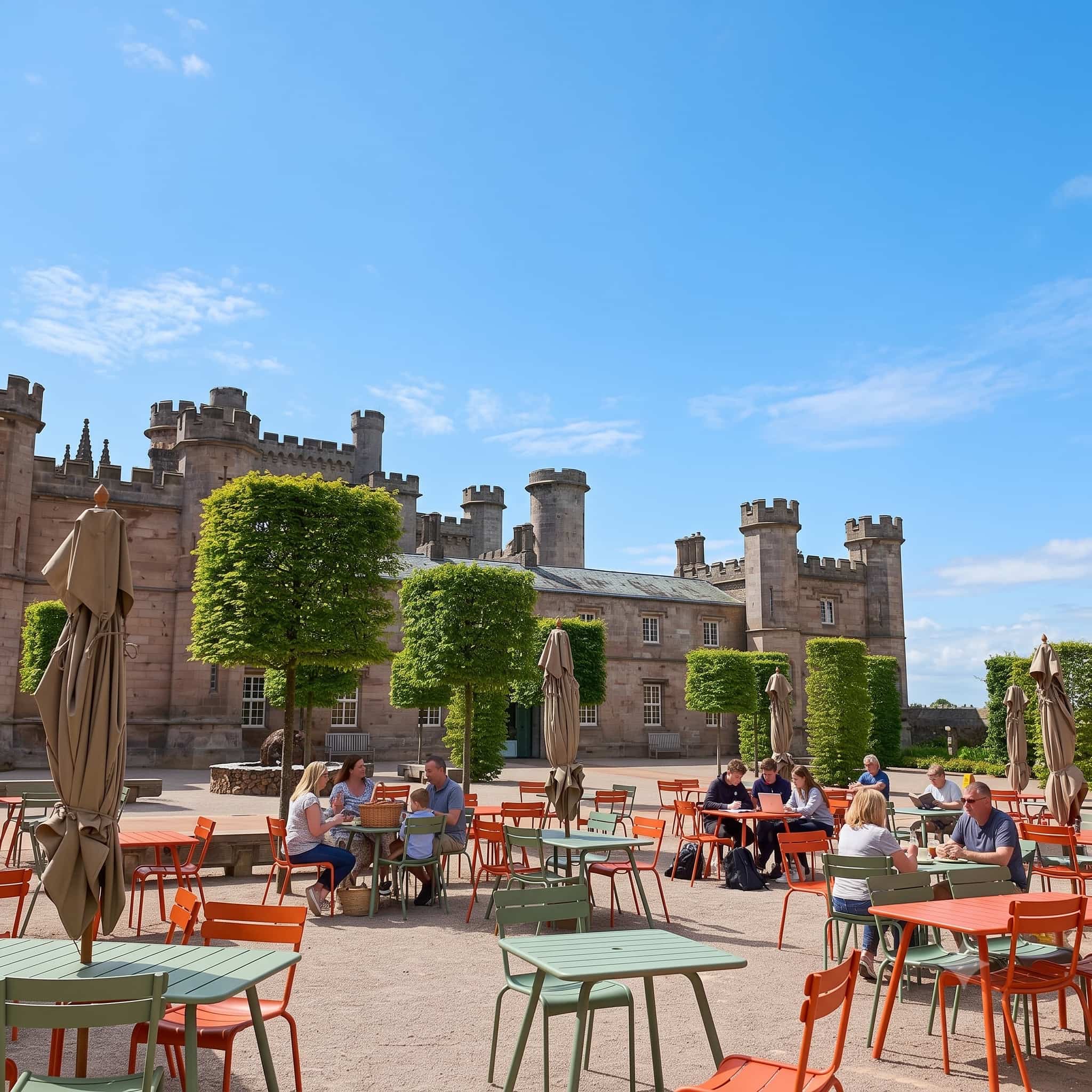
Courtyard seating. The ranges around it are roofed and still in use — the café is indoors, with tables outside when the weather allows.
Asked on every search we checked
Is there a café at Lowther Castle?
Yes — two of them, plus a takeaway. Worth clearing up first: it is only the main range of the castle that lost its roof. The service buildings around the courtyard are intact, roofed and still in daily use, and you can walk into the castle itself. The main café is one of those courtyard buildings — indoors, and table service. The takeaway is in the courtyard too, so if you would rather eat outside or keep moving you don't have to sit down for it. Food is freshly made and locally sourced where possible, with wine, beer and cider alongside teas, coffees and soft drinks.
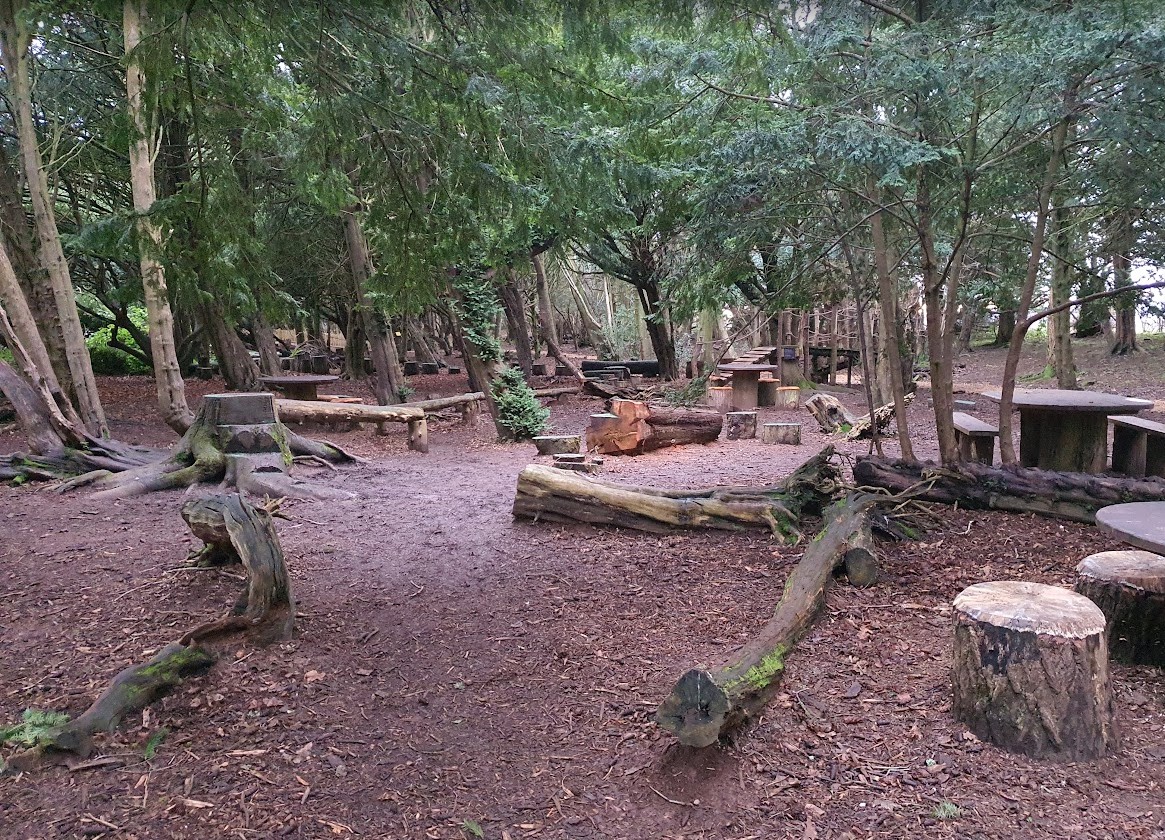
The second is into the woods, an outdoor café near the lost castle doing soup, sandwiches, drinks and ice creams, with tables and chairs made from fallen trees. It is not open year-round — it runs weekends and during school holidays, from mid-morning. If you are counting on it to feed children at the playground, check it is open on the day rather than assume.
Loos are in the courtyard and again over by the lost castle.
A note on the name: the main café doesn't trade under a separate name — it is simply the café in the courtyard, which is how the attraction signs it and how staff will refer to it. Only into the woods has a name of its own.
Both cafés are inside the paid area — you cannot visit them without a ticket.
The question the operator is quiet about
Can you take a picnic to Lowther Castle?
Lowther publishes no picnic policy — neither permitting it nor banning it. That is the honest answer, and it is worth stating plainly because most pages answering this question are guessing. There is no rule to point you at in either direction. If your day depends on it, ring Admissions on 01931 712192 and ask before you travel — it takes a minute and beats arriving with a cool bag and a problem.
What we can say without hedging: the free parkland is open ground. Take what you like out there, keep dogs on leads around the cattle, and carry your litter home — the estate asks exactly that.
Inside the paid area there is seating at both cafés, and outdoor tables by the playground. If you would rather not carry food in at all, the takeaway exists for precisely that.
Tickets
How much does it cost to get into Lowther Castle?
We don't publish Lowther's prices, and we would rather tell you why than quietly leave them out. Admission prices change, and at the time of writing the operator's own website carries different figures in different places. Publishing either set would mean half our readers arrive with the wrong number in their head. So: check the source before you travel.
What we can tell you without a figure
Tickets are sold per adult, per child (3–15) and as family tickets. Under-3s go free.
Carers are admitted free — bring proof and expect to be asked at Admissions.
Annual passes are sold for adults and children, with a discount for buying four or more together. They include unlimited entry and free parking — worth the sums if you are local or coming twice.
Parking is charged separately from admission. See the parking section below.
The operator asks you to book online ahead of your visit.
Concessions and 2-for-1
Lowther lists these membership and card schemes. All are card-holder offers — take the card with you, and check the operator's page for current terms before you rely on one.
Historic Houses — free entry for card-holders
English Heritage — 20% off for adult card-holders
CSSC — 20% off for card-holders
Gardeners' World — 2-for-1 for card-holders
My Cumbria — 2-for-1 for the card-holder plus a guest
There is no National Rail 2-for-1 at Lowther. It is widely repeated online and it is not among the offers the attraction lists — if you were planning around it, plan around one of the above instead.
The Lakes Planner is a planning guide. We don't sell tickets to Lowther and we're not connected to the attraction — booking goes direct to the operator.
Practical
How to pay for parking at Lowther Castle
Parking is a daily charge, separate from your entry ticket, and it applies at the castle car park and at Low Sawmill. There are three ways to pay:
RingGo app
Pay from your phone on arrival. A small booking fee applies on top of the parking charge.
At the tills
Pay at Admissions or in the café once you're inside. Useful if you have no signal.
With your ticket
Add parking when you book online — the simplest option, and one less thing on the day.
Adult annual passholders do not pay for parking — at Lowther, at Low Sawmill, and at the White Moss, Silverthwaite and Elterwater car parks in the central Lakes. That last part is the one people miss: if you park in the central Lakes with any regularity, the pass is doing more than getting you into Lowther. Price it up against a day ticket.
Remember the point from the top of this page: the charge applies whether or not you buy admission, so it catches out walkers who only wanted the free parkland.
History
What's special about Lowther Castle?
Plenty of English country houses fell down. Lowther is unusual because it was taken apart on purpose — and what was left was then kept, stabilised and opened up rather than cleared away.
There has been a house on this site since the family arrived in the twelfth century, and more than one has come and gone. The castle you see was commissioned in 1806 by William, 1st Earl of Lonsdale, and designed by Robert Smirke — his first major commission, years before he built the British Museum. It was a sham castle rather than a fortification: nine bays, angle turrets, battlements, all of it theatre. In its prime it was said to have a room for every day of the year, and a serious art collection to fill them.
Then it ran out of money. Hugh Lowther, the 5th Earl — the "Yellow Earl" — spent sixty years and a vast fortune on sport, horses and hospitality, and in 1936 the castle and gardens were simply abandoned. In the Second World War the grounds were requisitioned; a column of Matilda tanks arrived in October 1942 and tank regiments used the parkland to develop the Canal Defence Light, leaving the lawns under concrete.
The end came in 1957. Faced with a crippling death-duty bill and a house nobody wanted — it had been offered to three local authorities as a gift, and all three refused — James, the 7th Earl, had the roof removed and the contents stripped. Every chimney pot, door handle and fireplace was sold. What stood afterwards was a facade and outer walls. The forecourt became pig pens and the south lawns a broiler-chicken unit; the rest went under a spruce plantation.
Restoration began in earnest in the 2000s. The castle and 130 acres passed to the Lowther Castle & Gardens Trust, a registered charity, and the site reopened to the public in 2011 after a major consolidation of the shell — the first time it had been open in more than seventy years.
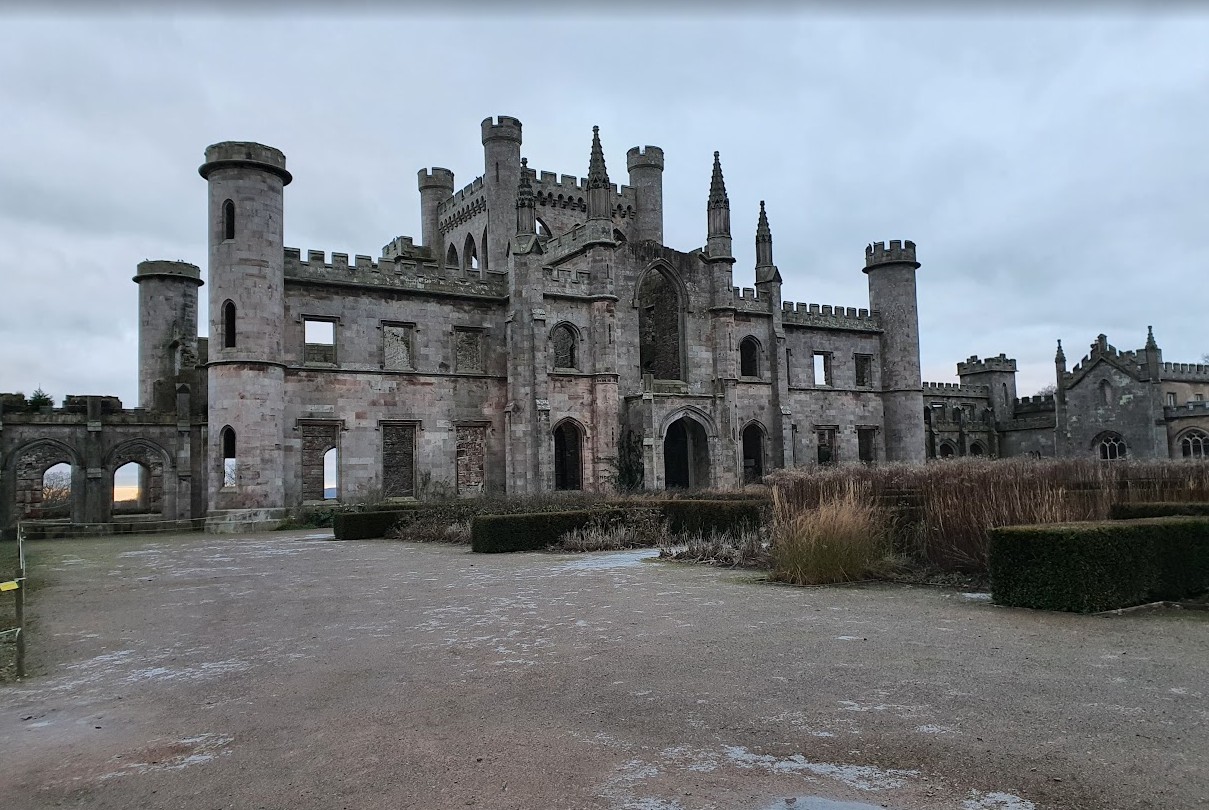
The garden front. Look through the windows and there is nothing behind them but sky — the clearest sight of what 1957 did.
Ownership, money and who's who
The Lowther family and the estate
These questions blur together in the search results because the castle and the estate are not the same thing. Below is what is on the public record. Where something concerns living private individuals or their finances, we have left it alone rather than guess.
How did the Lowther family make their money?
Land first, then industry. The Lowthers are one of the oldest arms-bearing families in the country and have held land in this valley since the twelfth century. Their wealth came from the estate itself and, decisively, from coal and iron — the family's own history is blunt that "coal and iron have frequently lined their breadbasket". Along the way they produced MPs, industrialists, agriculturalists and collectors; Pitt the Younger and Wordsworth were both protégés of the family.
Who is the current Lowther family?
The family descends in an unbroken line from Dolfin, of Viking descent, who settled at Lowther in 1150 — and is said to have given the river Lowth-a, "foaming water", the name the family took. The title is the Earldom of Lonsdale, and the family remain in the valley today, running the estate rather than the castle.
Who owns Lowther Estate now?
This is where the confusion lives, so it's worth separating clearly:
The visitor attraction — castle, gardens, playground, cafés — is run by the Lowther Castle & Gardens Trust, a registered charity, which took on the castle and 130 acres and reopened the site in 2011.
The wider Lowther Estate — the farmland, woodland and parkland around it — remains with the Lowther family, and runs its own conservation and nature-friendly farming operation.
Practical upshot: when you're checking tickets, opening times or events, you want the attraction. When you're reading about rewilding, farming or land management, that's the estate.
Short answer
Does anyone live in Lowther Castle?
No. Nobody has lived in the castle since the 1930s, and nobody could — there is no roof, there are no floors above ground level in much of it, and there are no interiors. It is a stabilised ruin, deliberately conserved as one.
Hugh Lowther, the 5th Earl, was the last resident. After the castle was abandoned in 1936 it was never lived in again, and the 1957 stripping removed any possibility of it. What you walk through today is consolidated stonework with the sky above it and planting growing inside the shell.
The distinction people are usually reaching for: the castle is uninhabited, the estate is not. The Lowther family still live and work in the valley — just not in that building. Askham Hall, nearby, is a separate property and not part of a castle ticket.
Honest assessment
Is Lowther Castle worth visiting?
It depends who you are, and the reviews that call it disappointing almost all come from people who arrived expecting something it has never claimed to be. Here is the trade-off stated plainly.
It suits you if…
You have children. The Lost Castle is the single strongest reason to come and will absorb them for hours.
You like gardens. 130 acres, a serious contemporary design layered onto seventeenth-century bones.
You find ruins more interesting than furnished rooms. This is a full-scale country house open to the sky.
You want a wet-weather-tolerant day near Penrith that isn't another indoor attraction.
You're local or coming twice — the annual pass changes the maths entirely.
It suits you less if…
You want a stately home interior. There are no period rooms, no furniture and no collection on display in the castle — it is an empty shell by design.
You need to stay dry all day. The main range of the castle is open to the sky and the gardens are the bulk of the visit — though the courtyard café, the shop and the exhibition are all indoors and under a roof if the weather turns.
Mobility is a concern. The attraction welcomes visitors of all abilities but says plainly that some terrain is not suitable for wheelchairs — ring ahead and ask.
You only want the view. You can get that from the free parkland without a ticket.
The scale is the point — this is a full-size country house with nothing behind the windows.And the other end of the scale — a garden door left ajar in the ivy.
How long to allow. The gardens and playground together are the bulk of it, and the operator's own framing — last entry an hour before closing — tells you they expect a substantial visit rather than a quick look. With children, plan on most of a day. Without, a half-day covers the ruin, the exhibition and the gardens comfortably.
A roofless house holds up better in midwinter than you might expect. On a hard, bright, frozen day the ruin is rather the point, and bare branches and low light suit it. Everything we walked to was open and available to look around.
For families
The Lost Castle adventure playground
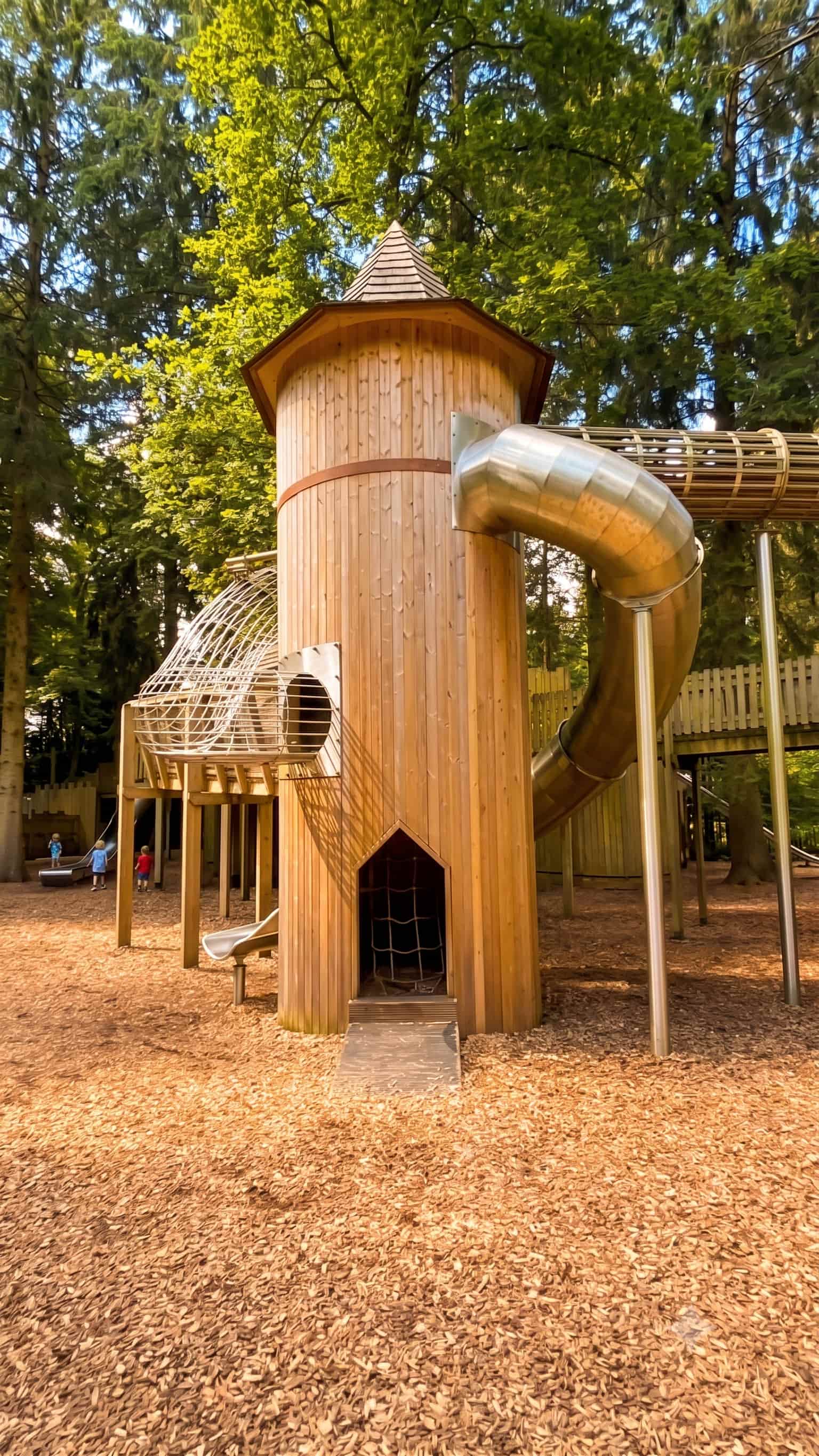
Its name is the lost castle — worth knowing, because it gets called all sorts of things elsewhere. It is one of the largest adventure playgrounds in the country, designed by CAPco, the Curious Adventure Play company, as an architectural echo of the castle itself and built from 25,000 metres of sustainable timber.
Ramps, steps, a fire pole, cages, crawl-throughs, a maze of turrets, zipwires, walkways and slides. Attached to it is the dragons' lair, with more cages and crawl-throughs and a turreted wooden building, plus a toddlers' area, a sandpit, a rope mesh and seating for the adults who have given up.
Age suitability: the separate toddlers' area means it works across a wide age range, and older children get the serious climbing.
Dogs are not allowed on the Lost Castle — for obvious safety reasons, as the operator puts it. They're welcome on leads everywhere else.
Check before you travel in bad weather. The playground can close in snow, ice or storms — and if it's the reason you're coming, that matters.
Lowther is a non-smoking, non-vaping site throughout.
into the woods, the outdoor café, is right beside it — see the café section above.
One of the turrets — the tube slide drops out of it, and the caged walkway runs off through the canopy.
It is not one structure but a whole stretch of woodland — felled logs, stumps and tables between the towers, with places for adults to sit.
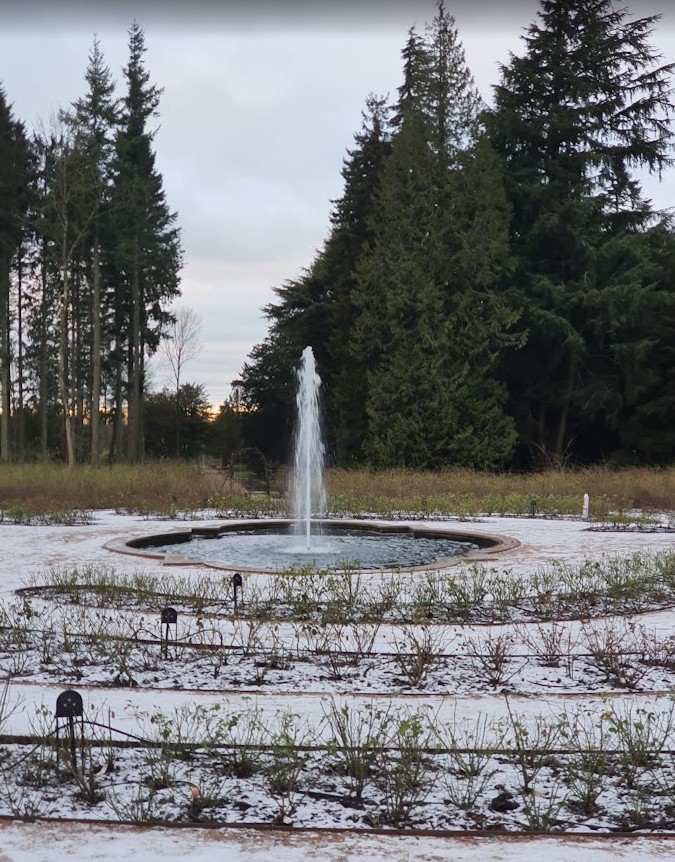
The Rose Garden fountain, still running with the beds under frost.
130 acres
The gardens at Lowther
The gardens were first formally laid out in the seventeenth century by the first Viscount, Sir John Lowther — the Great Yew Avenue dates from that period, complemented at the time by knot gardens growing fruit and vegetables for the kitchens of the old Lowther Hall. Later layers survive too: a Roman Bath and stone columns from the mid-Victorian period, and the Rock, Japanese, Sweet-Scented and Iris Gardens from the Yellow Earl's Edwardian enthusiasm for horticultural fashion.
Then fifty years of neglect. After the castle was abandoned the lawns went under wartime concrete, and in the 1950s the gardens were filled with commercial chicken sheds, a pig farm and a spruce plantation.
In 2008 the gardens were marked out for rescue and Chelsea Gold winner Dan Pearson was brought in on a twenty-year landscape masterplan. What you see now includes the Parterre, planted with herbaceous perennials, grasses and clipped yews; the Garden-in-the-Ruins, naturalistic planting among the castle's own stonework with a collection of botanical rarities; and the Rose Garden, laid out in the shape of an old English rose and inspired by the Sleeping Beauty myth.
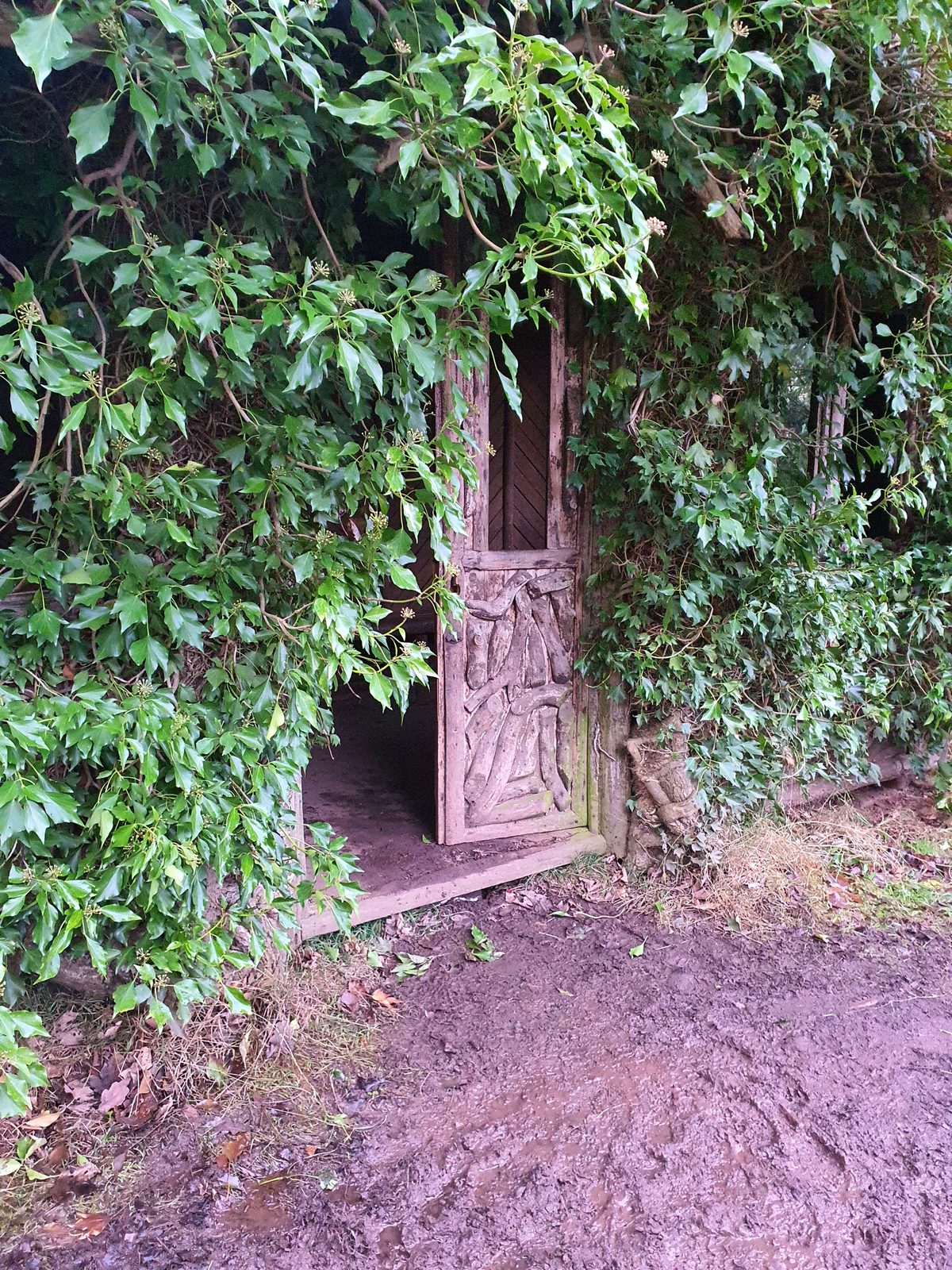
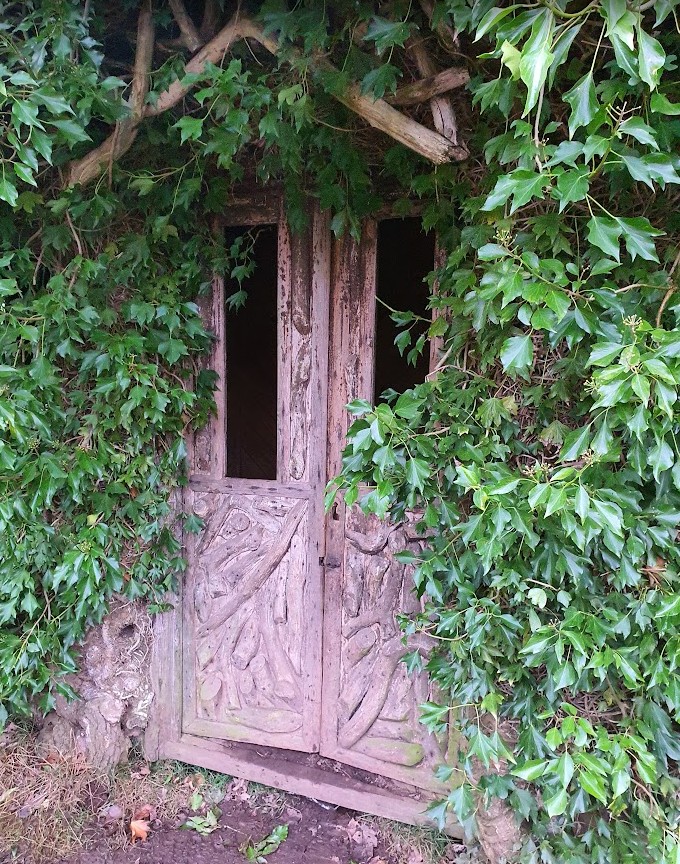
Elsewhere: clipped hornbeam sentinels in the courtyard, summerhouses, wildflower meadows, tree hives for wild bees and rambling woodland. Some of it you come across rather than find — doors set into the greenery, structures half-swallowed by ivy.
One of the garden's hidden doors, almost lost in the ivy.
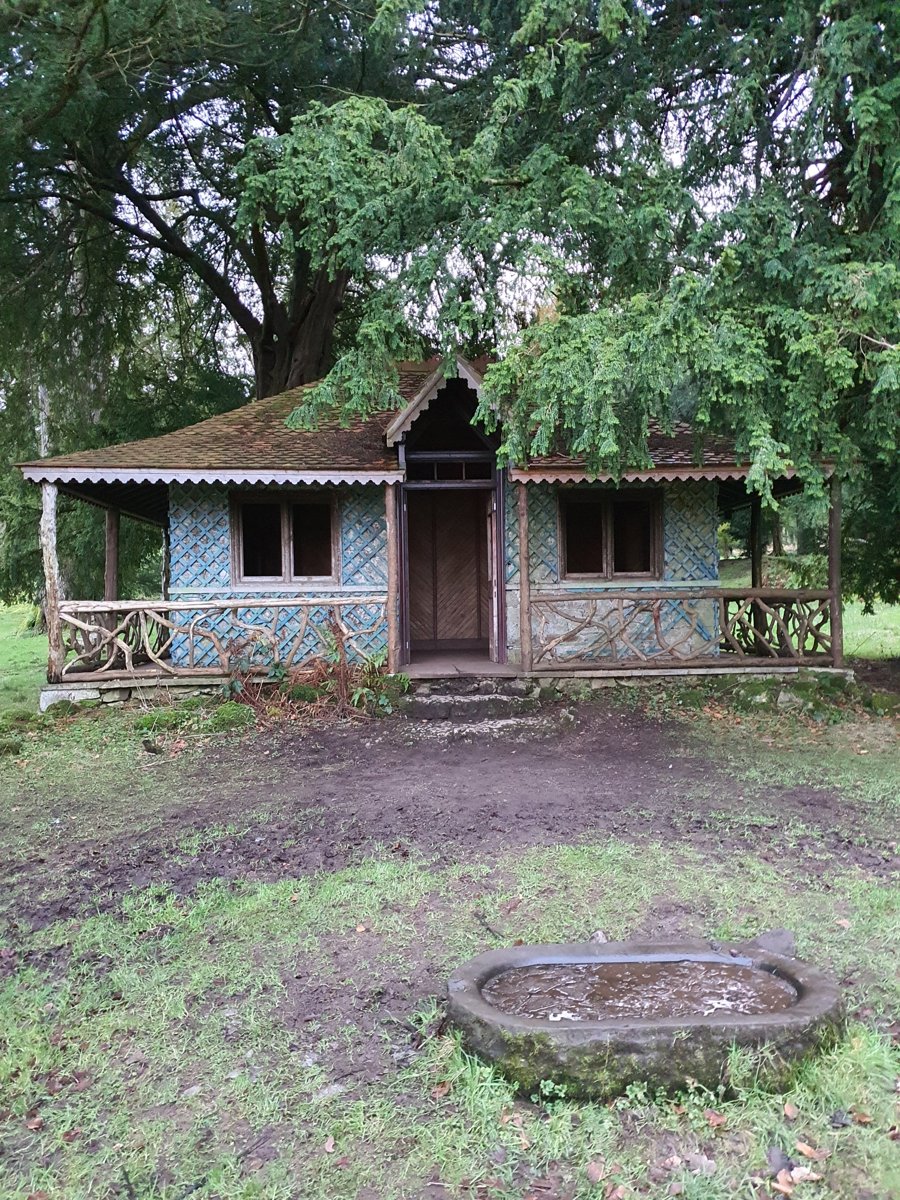
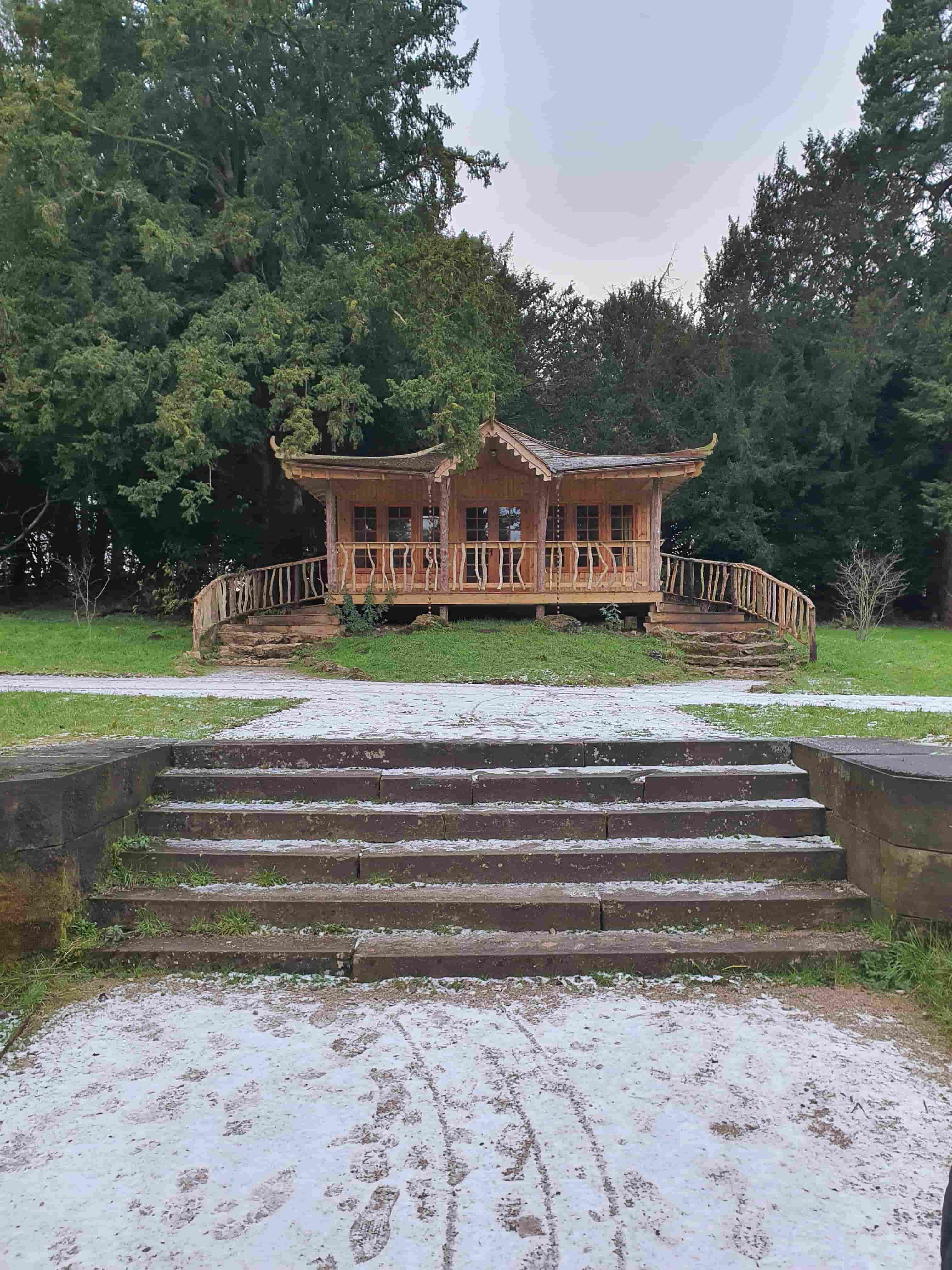
The summerhouses are the surprise. One in particular — a timber pavilion with a deep overhanging roof, rustic branchwork railings and a curved rail running round the front, set on a low mound above the grass — is worth the walk on its own, and looked extraordinary under a dusting of snow. Down by the larger ponds there are open-fronted timber shelters with benches inside, set to look straight out across the water, where you can sit out of the wind.
One of the garden summerhouses — branchwork railings, deep eaves, set above the grass.
Several of these summerhouses are dotted around the grounds — this one all but swallowed by ivy, its carved branchwork door still on its hinges.
Don't miss the Western Terrace — the view from it takes in the Lowther valley and the Lakeland fells beyond, and it is the one thing here that reminds you where you are.
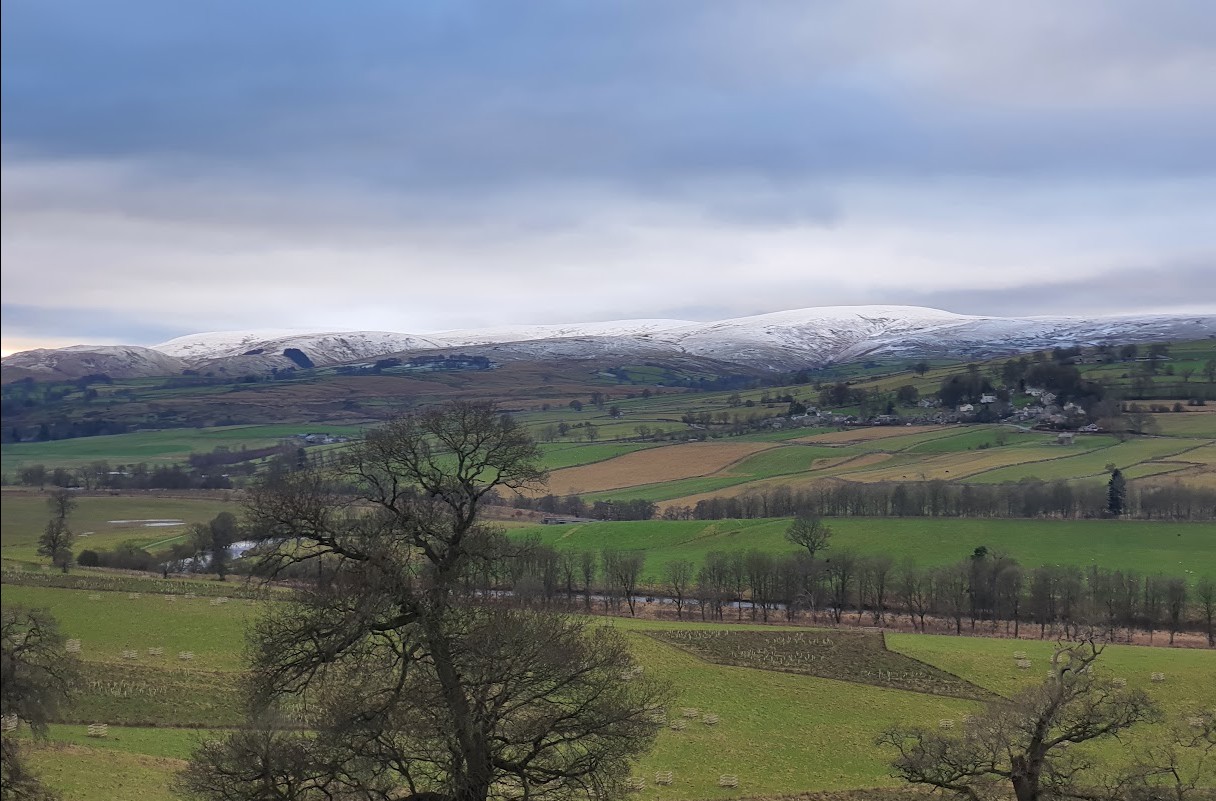
From the Western Terrace — the valley, the river and the fells under snow.
Practical
Getting there, parking and opening times
By car
From the north: M6 J40, A66 east to the next roundabout, then A6 south for 3 miles and follow the signs.
From the south: M6 J39, then A6 north for 8 miles and follow the signs.
From east or west: leave the A66 at Penrith and take the A6 south for 3 miles.
Sat-nav: CA10 2HH
Roughly 4 miles south of Penrith, and about 10 minutes from the town centre. Keswick is around 20 miles west via the A66.
By train and bus
Nearest station: Penrith (Penrith North Lakes), on the West Coast Main Line with direct services from London, Manchester and Glasgow.
Bus services do run past the castle from Penrith, but rural route numbers and timetables change often enough that we would rather send you to the source than publish a number that goes stale.
We've used the main car park at the castle itself. Parking is charged separately from admission, so budget for both.
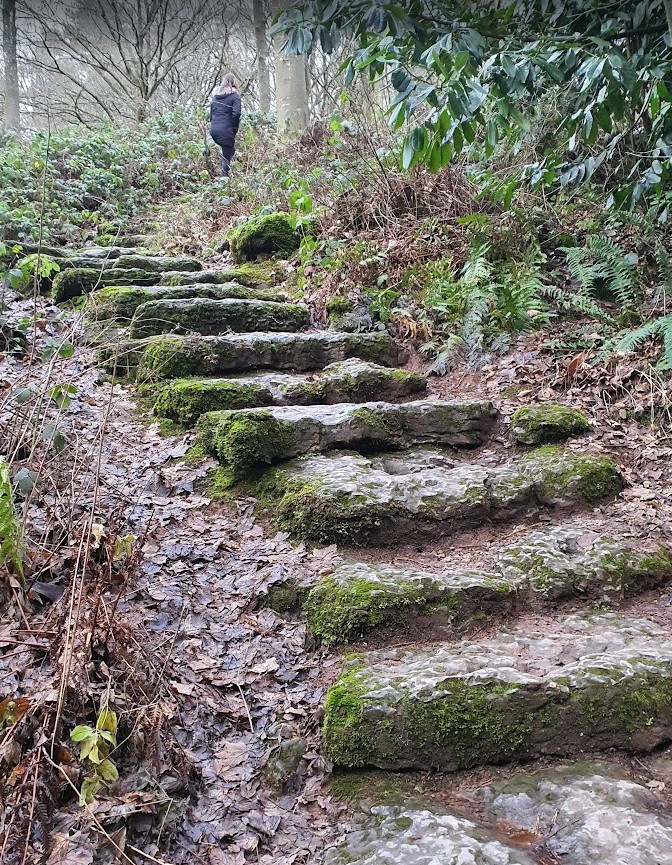
Accessibility. Lowther welcomes visitors of all abilities but is candid that some of the terrain is not suitable for wheelchairs — ask at Admissions for advice. If you need to drop a less mobile passenger close to the castle, ring 01931 712192 and staff will come out and help. Carers are admitted free; bring proof.
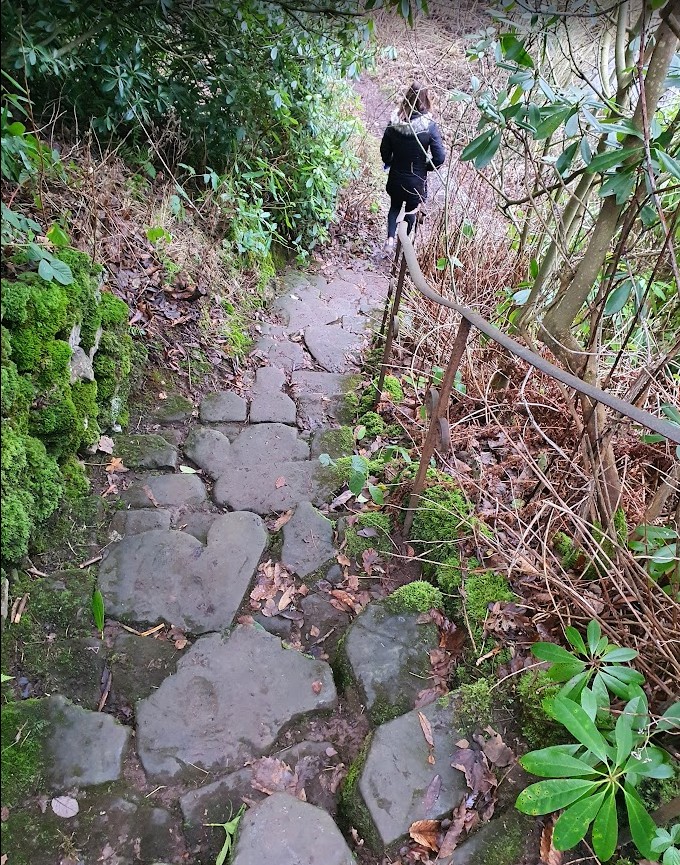
The photograph alongside shows the kind of ground that warning is about — old stone steps and slab paths through the woodland. Plenty of the site is level and firm, but not all of it.
Old stone steps in the woodland — uneven, mossy and not step-free.
Slab paths under the rhododendrons.
Getting about the site. Scooters and bikes are not allowed in the gardens, though there are bike racks in the courtyard if you have ridden over. Lowther is a non-smoking and non-vaping venue throughout. Loos are in the courtyard and again over by the lost castle, which is worth knowing before you set off into the woodland with children.
Dog-friendly
Dogs at Lowther
Dogs are welcome, and Lowther is one of the better big attractions in this corner of Cumbria for bringing one. The operator's wording: well behaved dogs are welcome provided they are kept on their leads at all times.
Where dogs can go
The gardens and grounds throughout, on a lead. And the free parkland outside the paid boundary, where the estate asks for leads wherever there is livestock — the Lowther Estate cattle herd roams loose, so in practice that means most of it.
Where they can't
Not on the lost castle adventure playground, for safety. If you are visiting as a family with a dog, plan for one adult to sit that part out — the seating and the outdoor café are right there.
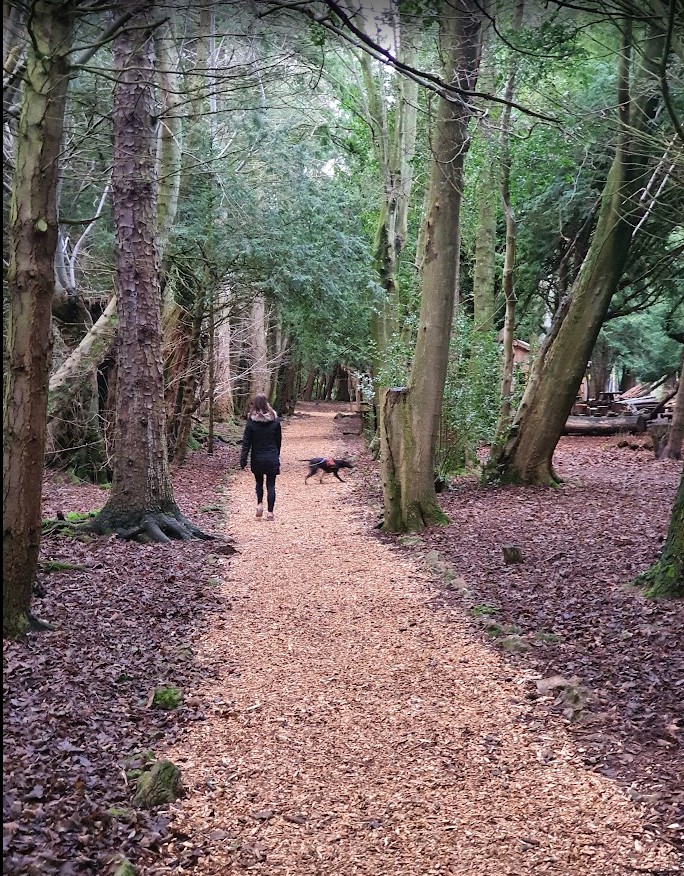
We've walked the grounds with our Staffy, Cass, on a frozen midwinter afternoon, and dogs were welcome throughout — nobody batted an eyelid. We keep her on a lead everywhere as a matter of course, so the leads-at-all-times rule cost us nothing. We saw no livestock on the day, and the paths we used were firm underfoot despite the frost.
Cass, our Staffordshire Bull Terrier, on the lead on the woodland paths.
Dog policy verified against lowthercastle.org. Policies do change — if your day depends on it, confirm before travelling.
What's on
Events and Christmas at Lowther
Lowther runs a full events programme — talks, theatre and cinema, tours, summer family events, and an illuminated Christmas trail through the ruins and gardens after dark, which is one of the better-known winter events in Cumbria and does sell out.
We deliberately don't list dates, line-ups or event prices here. Every one of those goes stale, and a guide that tells you about last winter's trail is worse than no guide at all. The operator's what's-on page is the only version that will be right when you read this.
Booking for the Christmas trail typically opens well ahead of the season and sells out early — if it's the reason you're coming, don't leave it late. This season's Lights of Lowther dates, checked with the castle, are on our Christmas in the Lake District page.
Some photographs are still being shot — where you see a placeholder, our own images are on the way.
Quick answers
Lowther Castle FAQ
Can you walk around Lowther Castle for free?
Partly. The wider parkland is free — the estate says visitors are welcome to walk anywhere in Lowther Park that is not marked private. The castle ruin, the gardens and the Lost Castle playground are all inside the paid boundary. And parking at the castle is charged whether or not you buy a ticket, so a genuinely free walk means starting from elsewhere. Cattle roam loose, so dogs go on leads.
Is there a café at Lowther Castle?
Yes, two plus a takeaway. The main café is in the courtyard and is table service, with wine, beer and cider as well as hot drinks; the takeaway is in the courtyard too. into the woods is an outdoor café near the lost castle doing soup, sandwiches, drinks and ice creams — but it opens weekends and school holidays only, from mid-morning. Loos are in the courtyard and by the playground. Both are inside the paid area.
How much does it cost to get into Lowther Castle?
We don't publish the figures — they change, and the operator's own site has carried conflicting prices. Check lowthercastle.org before you travel. Under-3s and carers go free, annual passes are available for adults and children, and parking is charged on top of admission.
Does anyone live in Lowther Castle?
No. Nobody has lived there since the 1930s. The roof and interiors were removed in 1957 and it is now a stabilised shell. The Lowther family still hold the surrounding estate, but not the castle building.
Is Lowther Castle worth visiting?
If you have children, like gardens, or find ruins interesting — yes. The Lost Castle is one of the largest wooden playgrounds in the country and the 130 acres of gardens are genuinely good. If you want furnished period rooms, no: there are none, and that is what disappointed reviewers were expecting. Allow most of a day with children, and remember it is almost entirely outdoors.
Are dogs allowed at Lowther Castle?
Yes — well behaved dogs on leads at all times, throughout the gardens and grounds. Dogs are not allowed on the Lost Castle adventure playground. Out in the free parkland, keep them on leads: the Lowther Estate cattle herd roams loose.
How do you pay for parking at Lowther Castle?
It's a daily charge, separate from admission. Pay through the RingGo app, at the tills in Admissions or the café, or add it when you book your ticket online. Adult annual passholders park free.
Who owns Lowther Castle?
The castle and 130 acres of grounds sit with the Lowther Castle & Gardens Trust, a registered charity, which reopened the site to the public in 2011. The wider Lowther Estate — farmland, woodland and parkland — remains with the Lowther family, who have held land here since 1150.
Make a day of it around Penrith
Lowther pairs naturally with the rest of the Penrith and Ullswater side of the Lakes — most of it within twenty minutes.